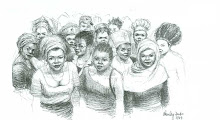
I care about meat stuck in my teeth
I care about humanity
I care about wearing a full hair on my head
I care about THE WOMAN
I care about the rhythm of music
I care that the voice of a woman is heard
I care about the love of a woman
I care about children
I care about life and death
I care about stoning a woman,
because it is inhuman
That is Why I care!
Submitted (22/9/13) in support of the Who cares about stoning? online Photo campaign of the WLUML Global campaign on Stop Stoning
Source: BAOBAB
Monday, October 7, 2013


Saturday, August 24, 2013
The Nigerian’s perspective of the WLUML’s global campaign to end the brutal practice of stoning
Sequel to the 57th session of the Commission on the Status of Women, where states were called upon to abide by their international human rights obligations and ban the act of stoning in countries where this still exists in law and practice. To this end, the Women Living Under Muslim Laws (WLUML) in collaboration with its global partners launched a campaign with the ultimate goal to end the brutal practice of stoning globally.
In the short-term by November 25, 2013, the International Day for the Elimination of Violence Against Women, this campaign seeks to garner a critical mass of 10,000 supporters worldwide to sign the online petition, advocating for a UN resolution against stoning on Change.org. In the medium-to-long term, the campaign’s goal is to completely ban stoning in countries where it still exists in law and criminalize those who engage in this heinous practice worldwide.
In line with this mandate, BAOBAB for Women’s Human Rights, as one of the joint partners in the WLUML global campaign to stop stoning, highlights this act from the Nigerian’s perspective. Stoning as a legalised form of punishment in Nigeria for sexual offences (such as adultery and fornication - Zina) can be traced back to the institution of Sharia penal code in the northern region since 1960, some of the punishments in its penal code includes 100 lashes (flogging) for engaging in any sexual relationship if the individual is unmarried.
In 1999, the Zamfara State governor at the time, reintroduced and expanded Sharia penal codes in the state. This action of implementing Sharia penal code was replicated by eleven other northern governors in their respective states, namely Kano, Katsina, Niger, Bauchi, Borno, Kaduna, Gombe, Sokoto, Jigawa, Yobe, and Kebbi. Stoning is the prescribed penalty in all these states as the punishment for women convicted of “illicit sexual affair”.
Stoning is an ancient form of capital punishment. There are historical reports of stoning from ancient Greece but the act of stoning is still retained by some religion till date, yet the act precede most religion. Stoning is often powered and executed based on misinterpretation of religious text and on cultural grounds; of which women are the most susceptible. Till date, stoning as an act of punishment for sexual offences (Zina) has never been implemented in Nigeria, although we have had near case occurrences which include:
- In 2002, Safiya Hussaini was the first woman to be sentenced to stoning in Sokoto State for giving birth to a child as a single woman. Her sentence was overturned on her first appeal.
- In 2002, Aminal Lawal was the second woman to be sentenced to stoning in Katsina State for adultery and conceiving a child out of wedlock. The father of the child was not persecuted for lack of evidence and deemed innocent by the court with a DNA test. Her conviction was later overturned.
The sheer possibility of the cruel punishment of stoning being executed in Nigeria is in itself a tormenting thought. Now is the time for Nigerians as well as citizens from any country where such an act exist in law and practice, to join this campaign against stoning and urge the UN to take action on abolishing stoning in law.
To join the campaign, click on this link United Nations Secretary General & the OHCHR: End Stoning Now
References
USCIRF Annual Report 2013 - Countries of Particular Concern: Nigeria
References
USCIRF Annual Report 2013 - Countries of Particular Concern: Nigeria
Friday, July 26, 2013
Press Release: The retention of the provision of Section 29(4)(b) in the amendment process of the 1999 Constitution of the Federal Republic of Nigeria.
BAOBAB for Women’s Human Rights (BAOBAB) strongly condemns the recent happenings with the Nigerian constitutional amendment process in the Senate to retain the provision of Section 29(4) (b) which says that “any woman who is married shall be deemed to be of full age", This provision would imply that a female child even at birth, if married, is deemed to be of full age.
This is particularly disheartening given the high rate of maternal mortality in Nigeria, primarily due to the prevalence of Vesicovaginal fistula (VVF) / Rectovaginal fistula (RVF). The majority of the cases of VVF in Nigeria are as a result of early girl child marriage. Early marriage in many instances leads to the withdrawal of girls from schools and thrusts upon them marital and reproductive responsibilities for which they are neither physically nor mentally mature to carry out.
BAOBAB sees this clause as a clear violation of the rights of the girl child and various international treaties such as:
- The Child Rights Act 2003: Section 21 & 22 which prohibits child marriage and betrothal .
- Convention of Elimination of All forms of Discrimination Against Women (CEDAW): Article 16 (2) which says the betrothal and the marriage of a child shall have no legal effect, and all necessary action, including legislation, shall be taken to specify a minimum age for marriage and to make the registration of marriages in an official registry compulsory.
- Protocol to the African Charter on Human and Peoples' Rights on the Rights of Women in Africa Article 6 (b) which provides that the minimum age of marriage for women is 18 years.
BAOBAB is using this medium to call on the National Assembly, Senate and the Nigerian government to:
- Remove the contentious provision of Section 29(4) (b) from the Constitution.
- Fulfill its obligations of implementing international treaties which Nigeria signed and ratified that would protect rights of the girl child such as The Child Rights Act, CEDAW & the Protocol to the African Charter
Signed:
Anne Lawal
Ag. Executive Director
BAOBAB for Women’s Human Rights
Monday, July 8, 2013
Stop Stoning of Women Global Campaign
In line with the newly adopted UN Security Council resolution 2106 (2013); States bear the primary responsibility to respect and ensure the human rights of all persons within their territory, as provided by international law. This embraces women’s political, social and economic empowerment as well as gender equality; it emphasizes that parties to armed conflict bear the primary responsibility to ensure the protection of civilians; including national ownership and responsibility to address the root causes of sexual violence in armed conflict.
BAOBAB for Women Human Rights, commend the effort of the UN in adopting the Security Council resolution 2106 (2013). We earnestly hope that States would embrace and put in law this resolution to provide great support for victims of torture. In this vein, we enjoin you to take part in the Stop Stoning campaign to end laws that promotes Violent Punishments and Torture Against Women such as stoning, by signing on to the petition (http://www.change.org/en-GB/petitions/united-nations-secretary-general-the-ohchr-end-stoning-now) and circulating the information amongst your networks. Thank you
Friday, April 12, 2013
In Memoriam of Sindi Medar-Gould

With a heavy heart and
deepest sorrow we, the entire staff of BAOBAB For Women’s Human Rights
(BAOBAB) announce the sudden demise of Sindi Medar Gould the former
Executive Director of BAOBAB, Sindi Medar-Gould a citizen of St Lucia in
the Caribbean, was a great feminist, facilitator, researcher &
activist for women’s human rights in Nigeria and globally. She
contributed a great deal to the emancipation and empowerment of women
and girl children. Sindi’s last appointment was with the Women’s
Learning Partnership for Rights, Development & Peace (WLP), as a
Senior Consultant and Global Trainer. Sindi also worked with various
women human rights organizations and movement. She touched many lives
and helped to give women a reason to live a life with hope for a better
tomorrow. She would be greatly missed and remembered as a great leader.
Farewell Sindi!!!
Signed
Mma Odi
Executive Director
BAOBAB for Women’s Human Rights
Click here to read tributes from people whose lives Sindi has touched
Wednesday, February 13, 2013
COLOUR TAG FOR “VIOLENCE”
Counting down “one” day to the “V” day (February 14), What colour would you tag “VIOLENCE” besides colour red and why? Let's hear your views....

Thursday, February 7, 2013
Women in Conflict and Peace-Building
Over the past two decades, Nigeria has experienced increased levels of insecurity and violence which has claimed many lives and property. The state of insecurity has affected virtually every aspect of social and economic development and women have so far been especially affected by such violence and insecurity because of their peculiar roles as homemakers, caregivers as well as their relatively poor economic status.
Unarmed women and children thus continue to bear the brunt of massacres that occur in different parts of the country, especially in northern Nigeria. The mass killing that occurred in Jos, Plateau state in 2010, for example, resulted in the death of many Nigerians most of whom were women and children. To date, the number of the victims affected by that massacre has not been confirmed. In recognition of the precarious situation that women found themselves in that tragedy, many women organized a peaceful “wailing” protest in Abuja demanding justice and protection from such attacks. The massacre brought about condemnations from both local and international agencies and government officials. It also brought to light women’s interest and role in peace building processes that aim to provide rehabilitation for victims of conflict and establish preventive systems.
Recent events of conflicts, bombing of commercial and public places in Nigeria show that conflicts must be managed, not ignored and there must be concrete efforts for peace building. Such processes must also be completely inclusive of all interests represented in the country. Without peace there can be no meaningful development and without women’s involvement in the design and implementation of policies and programs on conflict resolution and peace-building such activities will fail to achieve its purpose. On October 31 2000 the United Nations Security Council unanimously adopted the Security Council Resolution 1325 (SCR1325), stating in article 2 of the Resolution: “Reaffirming the important role of women in the prevention and resolution of conflicts and in peace-building, and stressing the importance of their equal participation and full involvement in all efforts for the maintenance and promotion of peace and security, and the need to increase their role in decision- making with regard to conflict prevention and resolution”. In addition, various other international and regional instruments as well as the Constitution of the Federal Republic of Nigeria states clearly women’s right to protection in conflict situations and their involvement (without discrimination) in peace building and conflict resolution processes. Nigeria is signatory to a host of such international instruments and laws.
BAOBAB for Women’s Human Rights in recognition of the rights of women in conflicts situation and peace building process dedicates her 2013 calendar to women in conflicts. The 2013 calendar highlights quotations from legal instruments that outlaw violence against women in conflicts and recommend women’s involvement in peace-building processes.
Subscribe to:
Posts (Atom)